
Run Your Race: A Therapist's Guide to the College Transition
Transitioning to College
Well, it’s that time of year again, and something about this year may feel a bit different for you. Maybe last year, the focus was on your next-door neighbor or best friend. The year before that the attention was on your sibling, and you just gave them a big hug and went right back to your normal and comfortable routine. This year, it’s your turn. The big moment is finally here after 18 years. You did it. You are headed off to college.

That day everyone told you would come is finally here, and you are supposed to feel excited and pumped. But instead…you feel like breathing into a paper bag to catch your breath from the intense panic you can’t shake. ‘This can’t be right, I’m not supposed to feel this way.’
But the truth is, graduates and parents, this is a big moment, and anxiety is a completely appropriate feeling to have, because you care. You want to do well, but in the end, we can’t predict the future.
This blog post is not about taking away anxiety or insecurties; this post is about validation. For graduating teens or those nearing high school graduation, what you are feeling at this moment is real and expected. And while I can't make any guarantees it will get better, In can tell you that for many what you are feeling now shall pass. After working for over 10 years at a prestigious college counseling center in Houston, TX, I have learned a lot about the challenges that come with the transition to college, and my hope is to share some of that wisdom to help you get ready.
Sprint vs. Marathon
While most high school students have not run a marathon, most understand what it’s like to get ready for some type of big upcoming event: a test, a big game or performance, an important social event. Most would tell you that they did not simply show up and crush it. Getting ready was a process that took weeks, months, or even years. Yet no matter how much you prepared, you were still nervous on “race day.” You showed up to the starting line feeling confident, knowing you had done all you could, while at the same time doubting yourself and expecting nothing less than perfection. But the moment that starting horn sounded, some of that anxiety disappeared and you began to run your race.
Going to college is not a sprint. It is truly a marathon. You have to pace yourself and run your race. One of the biggest mistakes college students make is trying to do too much in their freshman year, especially their first semester. You come in with overly ambitious career and social goals, take the hardest classes, and join every single club or social event you can find. You sprint the first mile not realizing you have 25 miles to go. This sets you up for burnout, anxiety, poor academic performance, and unrealistic social expectations.
Run Your Race
Take a course load that allows you the time to orient yourself to your campus and community. Freshman year is about exploration, not conquest. Explore what is out there on your college campus which means you are learning to embrace that anxiety may paralyze you. When you seek the same friends, the same indenties, the same life you had in high school, you ultimately are missing the whole point of your journey through college into adulthood.
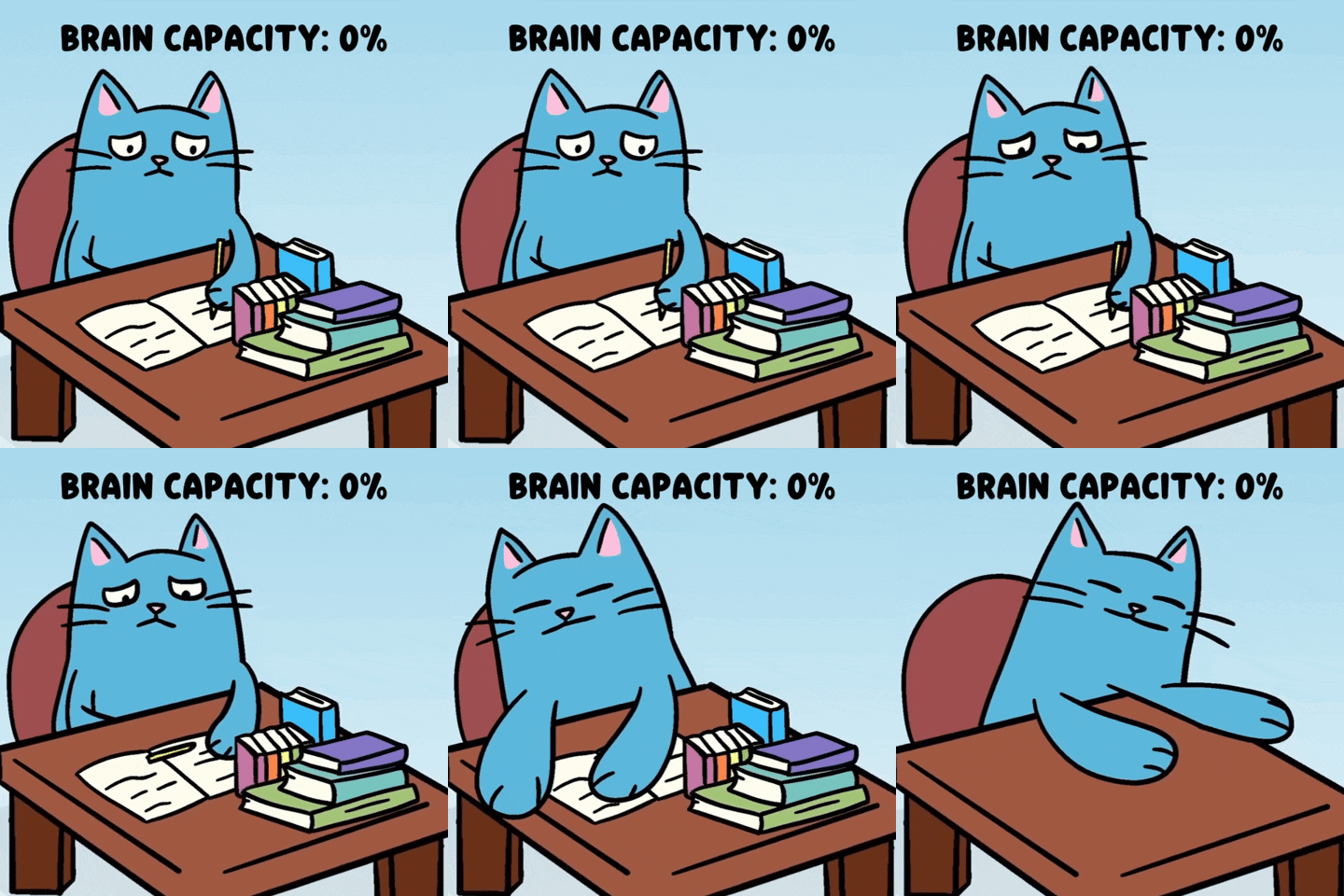
Socially, there can be pressure to find your people by the end of week one. Some colleges even overly emphasize finding your forever friends during orientation or the first week of classes. True relationships are built on trust and vulnerability, and there is no rushing this process. Learn to make many connections that may build into close friendships over time. By taking the pressure off yourself to make forever friends, you may find it easier to be comfortable finding your people, not just any people. Four years is a short time in the span of a life, but you must learn to journey every single mile. Don’t rush the process; enjoy it.
The Identity Shift
Dependence to Independence
As someone who has sat across from hundreds of incoming freshmen, I can tell you many often arrive with the illusion that they are fully prepared for what comes next. They believe they have been living independently for years and have everything they need to be on their own. They come onto campus appearing confident, ready to conquer the world.
But as the dust settles, they begin to recognize how much the support systems around them kept them afloat. Parents who managed their schedules, cooked and cleaned for them, handled their money, and provided constant reassurance and emotional support. Teachers and coaches who were easier to access and personally knew their stories. Friends who had gone to school with them for years and knew them better than anyone.
What makes this harder is that students are arriving less prepared than previous generations. Parents and schools have become increasingly involved in teenagers’ lives, often in the name of boosting college admissions prospects. The result: students who may be cognitively sharper than any generation before them, but who are socially and emotionally less equipped for what independence actually demands.
Overnight, all of those support systems, ones that may have been taken for granted, are gone. You are now pseudo-independent. You have to manage your own class schedule, track your own money, structure your free time, do your own laundry, build a healthy sleep routine, stay on top of your health, all while navigating a burgeoning social life.
And somewhere in the middle of managing all of that, you’re also being asked to figure out who you actually are.
The Great Search for Self
College freshmen, and honestly most college students, enter my counseling office with stories that are different on the surface but rooted in two core needs: certainty and acceptance. They want certainty that the career path they choose will lead somewhere meaningful, that their high school relationship will survive college and long distance. They want to be accepted by their new friends and held by the unwavering love and support of their families.
Leaving behind the roles you have carried for years, athlete, honor student, drama kid, class comedian, can feel like stepping into the wilderness. These were not just labels. They were the building blocks of how you understood yourself, and how others understood you.
As a college counselor, one of the greatest challenges I see is students moving from environments where they were the standout to a campus filled with other students who were also the standout. The identity they thought was solid suddenly crumbles beneath their feet. They become just like everyone else. And in a world where everyone wants to stand out, being just another student is terrifying.
But remember: wandering into the wilderness is uncomfortable, and it is supposed to be. College is not about attaching yourself to new roles and labels driven by external validation and approval. It is about figuring out who you are based on your strengths and values. I often tell college students not to choose based on convenience. Choose relationships based on your value system, and stronger connections will follow.
Your identity is not lost. It is just finally being written by you.
The Secret Comparison Game
What if I picked the wrong major? What if my roommate is smarter than me? What if everyone else already knows what they want to do with their life, and I am still figuring out what to eat for breakfast? Welcome to the comparison game, and college is one of its most competitive arenas.
Comparison is not new. You have been doing it since middle school. But in college, the pool is bigger, the stakes feel higher, and social media ensures you are never more than a scroll away from someone who appears to be doing it better than you.
The start of the semester is always the busiest time of year due to the influx of college freshmen onto campus. For many students, their struggles begin at orientation, even before classes start. Students begin to size themselves up against others based on nothing more than speculation and appearance. For most, they place themselves somewhere near the bottom, creating a narrative of shame and self-doubt that results in feelings of loneliness and isolation.
By sophomore year the comparison shifts. It is no longer just about fitting in at the dining hall.
Now it is about grades. Internships. Research positions. Who had the more impressive summer.
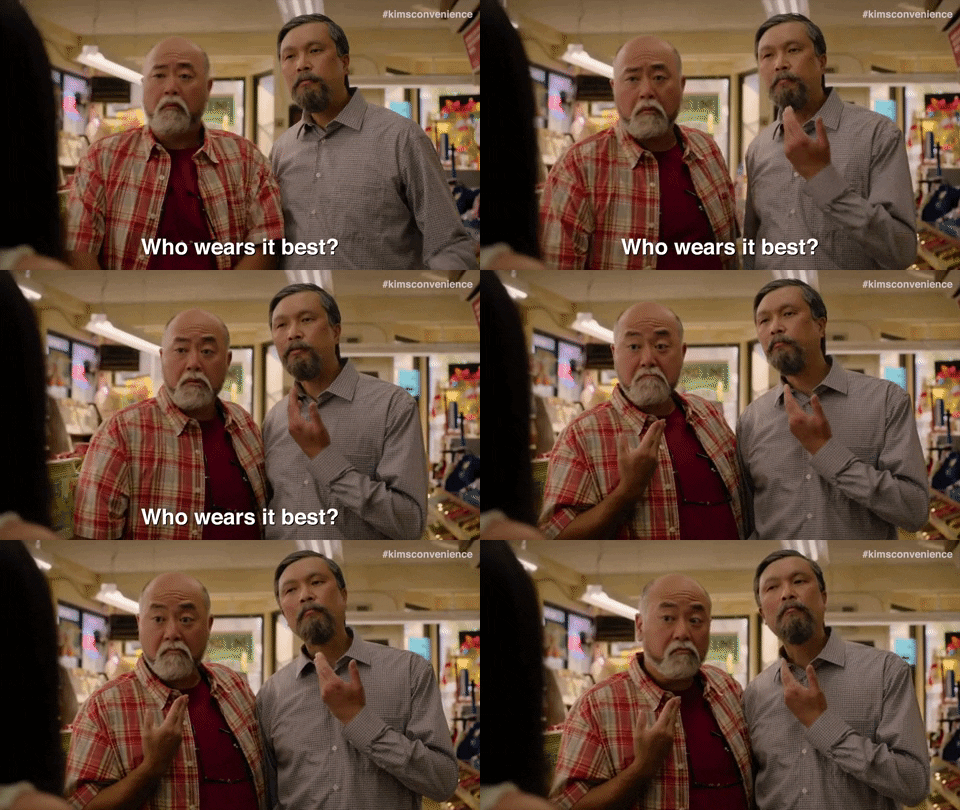
Students begin asking ‘what did you get on the exam?’ before they ask how each other are doing. The grade curve does not help. It structurally pits students against each other, turning the classroom into a competition before anyone has said a word.
By senior year the comparison becomes existential. It is no longer about grades.
It is about what you are doing after graduation, where you are going to graduate school, what company you are joining, what city you are moving to.
The question stops being ‘am I doing okay?’ and becomes ‘what does my path say about who I am compared to everyone else?’
Here is what I want you to know. Comparison is a thief.
It steals the experience you are actually having by replacing it with the experience you think someone else is having.
And that experience you are imagining? It is almost never accurate. And even if it is, context is always limited.
You are measuring your internal reality against someone else’s external performance.
I have had the pleasure of watching students mature before my eyes over the course of four years, students from different backgrounds and life circumstances.
One thing that always stands out is that no matter how much insecurity a student entered with, they are always proud of themselves for having run the race.
No matter the mistakes they made along the way, I remind them that their adult life is only just beginning, and that the race they ran, with all its stumbles and detours, was exactly the race they needed to run.
You will never be perfect enough, but you can always be good enough.
You do not have to be the best version of everyone in the room. You have to be the best version of yourself. And figuring out who that is, without the noise of comparison drowning it out, may be the most important work you do in college.
Final Thoughts
Going to college is one of the most significant transitions a person goes through.
It asks you to run a marathon you have never trained for, manage a life you have never fully managed, build an identity you have not yet discovered, and resist comparing your starting line to everyone else’s mile marker.
That is a lot to carry.
But here is what I have learned from years of sitting across from college students: the ones who struggle are not the ones who are doing it wrong.
They are the ones doing something genuinely difficult.
The ones who find their footing are not the ones who had it all figured out. They are the ones who were willing to ask for help, stay curious about who they were becoming, and run their own race.
You are going to be okay. Not because college is easy, but because you are more capable of growing through discomfort than you know. If you find yourself struggling along the way, you do not have to figure it out alone. A campus counselor, a trusted mentor, or a therapist can make a meaningful difference. My door is open if you need it.
Now go run your race.
